When Markets Collide: How Cross-Asset Momentum Blindsides Even Your Most Precise Forex Setups

The Flaw Built Into Single-Market Analysis
Most retail traders in the United States approach forex and CFD markets the same way: they isolate a single currency pair or instrument, apply their preferred technical framework, and execute based on what that chart tells them. The logic is clean. The discipline is real. And yet, the trade fails in ways the setup never suggested it would.
The culprit is rarely the analysis itself. It is the assumption underlying that analysis — that a single market can be understood in isolation from the broader financial ecosystem moving around it.
Cross-asset momentum does not announce itself. It does not wait for your technical setup to complete before reshaping the environment your position inhabits. By the time the disruption is visible on a forex chart, the institutional capital that caused it has already rotated through three other asset classes.
What Cross-Asset Momentum Actually Means
The term gets used loosely, so it is worth being precise. Cross-asset momentum refers to the directional persistence of price movement that originates in one market and propagates into others through correlated capital flows, risk sentiment shifts, and macro repricing events.
Consider a practical example familiar to US traders. Treasury yields rise sharply following a stronger-than-expected jobs report. That move is not contained to the bond market. Rising yields strengthen the dollar through interest rate differential logic, pressure gold as a non-yielding asset, and simultaneously rattle equity indices as discount rates adjust upward. A trader holding a long EUR/USD position based purely on a technical breakout pattern now finds that position fighting a macro current that has nothing to do with the euro-specific narrative they were tracking.
The setup was not wrong. The environment around it changed faster than single-market analysis could register.
The Institutional Playbook Most Retail Traders Never See
Large institutional participants — hedge funds, sovereign wealth funds, major bank prop desks — do not analyze markets in silos. Their risk models are multi-dimensional by design. When a macro event triggers a positioning adjustment, the rebalancing happens across asset classes simultaneously. Equity exposure gets trimmed, bond duration is adjusted, commodity hedges are repositioned, and currency exposure shifts accordingly.
This coordinated movement creates what experienced market observers call a cascade effect. The initial trigger might be a Federal Reserve statement, a commodity supply shock, or a geopolitical development. The cascade that follows moves through asset classes in a sequence that experienced cross-asset traders learn to anticipate.
For US traders specifically, the dollar's role as the world's reserve currency means that nearly every significant cross-asset rotation eventually expresses itself through dollar-denominated pairs. Ignoring what is happening in crude oil, the 10-year Treasury, or the S&P 500 while trading USD pairs is not just incomplete analysis — it is leaving a major variable entirely out of the equation.
Recognizing Correlation Breakdowns Before They Become Losses
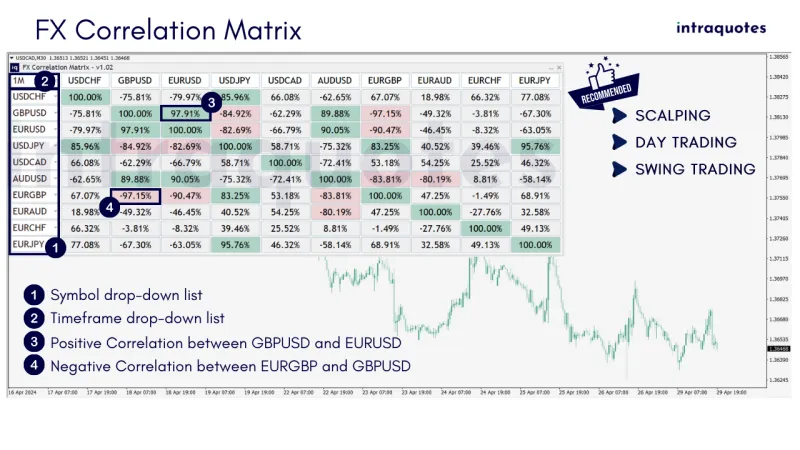
Here is where the real analytical opportunity lies. Cross-asset momentum shifts rarely arrive without warning signals. What changes before a major directional move is not the direction itself — it is the correlation structure between asset classes.
Under normal market conditions, certain relationships hold with reasonable consistency. The dollar tends to move inversely to gold. Risk-on sentiment typically supports commodity currencies like the Australian dollar. High-yield credit spreads often lead equity volatility. These relationships are not laws — they are tendencies that reflect prevailing macro consensus.
When those correlations begin to break down, it signals that the prevailing consensus is being challenged. Institutional positioning is shifting before the narrative has fully updated. A trader watching only their primary instrument will see nothing unusual. A trader monitoring correlation consistency across related assets will notice the divergence.
Practical monitoring does not require sophisticated infrastructure. Watching the relationship between the DXY and gold, or between crude oil and the Canadian dollar, or between US equity futures and the Japanese yen, provides meaningful early signals. When those historically stable relationships begin moving out of sync, the probability that a significant repricing is underway increases substantially.
How to Integrate Cross-Asset Context Into Your Trade Analysis
Incorporating cross-asset awareness into your workflow does not mean abandoning technical analysis or becoming a macro economist. It means adding a contextual layer that validates or challenges what your primary setup is suggesting.
Before entering a position, ask three questions. First, what is the current risk sentiment environment, and is the asset class you are trading aligned with that sentiment or fighting against it? Second, are the markets most closely correlated with your instrument behaving consistently, or are there signs of divergence? Third, is there a scheduled macro event in any correlated market — a Treasury auction, an oil inventory report, a major equity earnings release — that could trigger a sentiment shift during your trade's holding period?
These questions take minutes to answer and can prevent the kind of loss that leaves traders baffled because their chart work was technically correct but contextually blind.
The Timing Problem and Why It Matters More Than Direction
Even traders who understand cross-asset dynamics often underestimate the timing dimension. Correlation breakdowns can persist for days or even weeks before resolving into a clear directional move. During that window, volatility expands, false signals multiply, and positions built on pre-breakdown analysis get stopped out repeatedly.
The institutional approach to this problem is not to force a position during the breakdown phase. It is to reduce exposure, widen risk parameters, and wait for the new correlation structure to stabilize before re-entering with conviction. Retail traders who refuse to acknowledge the breakdown phase — who double down on a thesis because the chart still looks valid — are fighting a battle that the macro environment has already decided.
Patience during correlation breakdown periods is not passivity. It is the recognition that the highest-probability setups emerge after the new regime has established itself, not during the chaotic transition between regimes.
Building a Broader Analytical Framework
The traders who consistently navigate cross-asset momentum shifts successfully share a common characteristic: they treat their primary instrument as one piece of a larger picture, not the picture itself. They maintain awareness of what bond markets are pricing, what commodity flows are suggesting, and what equity risk appetite is signaling — not because they trade all of those markets, but because those markets tell them something essential about the environment their positions are operating in.
For US traders working with forex and CFD instruments on platforms like IC Markets ZHV, the tools to build this awareness are accessible. The discipline to use them consistently is what separates traders who get blindsided from those who see the shift coming and position accordingly.
The pattern nobody talks about is not complicated. It is simply invisible to anyone who never thought to look beyond their primary chart.