Synchronized to Fail: How Currency Pairs Lose Their Independence Under Market Stress
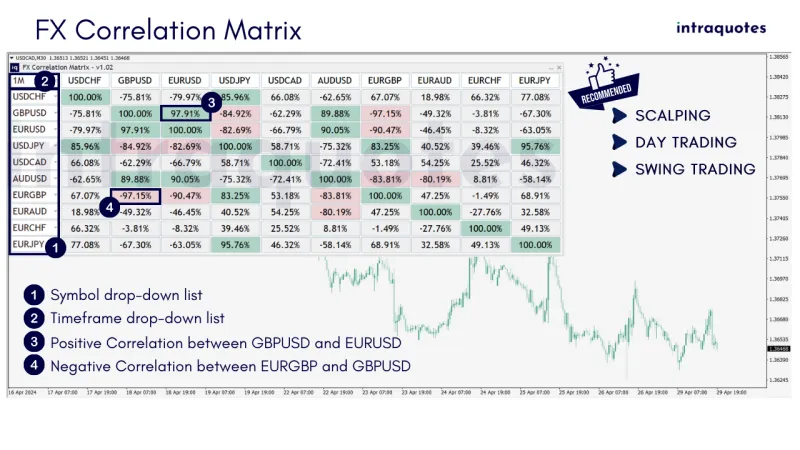
Photo: forex trading multiple currency pairs charts correlation financial stress, via c.mql5.com
Diversification is one of the oldest principles in risk management, and for good reason. When assets respond to different economic forces, losses in one position can be offset by stability—or gains—in another. In forex, this logic leads many active traders to hold positions across multiple currency pairs simultaneously, treating EUR/USD, USD/JPY, and AUD/USD as genuinely independent bets. Under normal conditions, that assumption holds up reasonably well. But markets are rarely normal for long.
When stress enters the system—whether through a Federal Reserve policy surprise, a geopolitical flashpoint, or a sudden liquidity crunch—the individual drivers behind each pair tend to fade into the background. What replaces them is a single, dominant force: risk sentiment. And risk sentiment does not discriminate between your carefully selected positions. It moves them all at once.
Why Independent Pairs Stop Being Independent
The root of the problem lies in how institutional capital responds to uncertainty. During calm periods, a fund managing exposure to EUR/USD is primarily reacting to eurozone growth data, ECB communications, and transatlantic interest rate differentials. Meanwhile, a position in AUD/USD is driven by commodity prices, Chinese demand signals, and Reserve Bank of Australia policy expectations. These are genuinely separate narratives.
But when a macro shock arrives, portfolio managers across the globe begin executing the same playbook simultaneously: reduce risk, raise cash, move toward safe-haven assets. The US dollar, Japanese yen, and Swiss franc attract capital regardless of their individual fundamentals. Commodity-linked currencies—the Australian dollar, Canadian dollar, and New Zealand dollar—sell off together. Emerging market currencies face coordinated outflows. The result is a market-wide compression of correlation toward 1.0, precisely when traders believe their books are diversified.
This is the correlation trap. It does not announce itself. It simply arrives, and by the time most traders recognize it, the damage is already reflected in their P&L.
The Geopolitical Trigger: A Recent Case Study
The dynamics described above were clearly visible during the weeks surrounding escalating tensions in Eastern Europe in early 2022. Prior to the event, EUR/USD and USD/CAD were trading with relatively low correlation—Europe's energy exposure and Canada's oil-linked economy created divergent narratives. Once the conflict intensified, however, both pairs began tracking a single theme: dollar strength as a safe-haven destination.
Traders holding short EUR/USD alongside long USD/CAD—a position that might appear balanced—found that both legs moved against them in concert. The expected hedge had evaporated. A similar dynamic played out during the March 2023 US regional banking stress, when a broad risk-off wave temporarily synchronized pairs that had been trading on distinct fundamental stories for months.
These are not outliers. They are a structural feature of how global capital moves under pressure.
Detecting Correlation Shifts Before They Become Costly
The practical challenge for US traders is identifying when independent pairs are beginning to synchronize before the full re-pricing takes hold. Several analytical approaches can provide early warning.
Rolling correlation windows are among the most accessible tools. By calculating the 10-day or 20-day rolling correlation between the pairs in your book, you can observe when relationships that typically sit near zero begin trending toward 0.6 or higher. That directional shift—rather than the absolute level—is the signal worth monitoring. A correlation that was 0.1 three weeks ago and is now 0.45 deserves attention even if it has not yet reached what most traders consider a dangerous threshold.
Implied volatility skew in the options market is another leading indicator. When the skew on multiple currency pairs begins tilting in the same direction simultaneously—particularly toward dollar calls or yen calls—it suggests that institutional hedgers are anticipating a unified risk-off move rather than pair-specific adjustments.
Cross-asset confirmation adds a third layer. When US equity index futures begin selling off sharply, Treasury yields drop in tandem, and gold breaks above recent resistance, the probability of synchronized forex moves increases substantially. Monitoring these relationships in real time allows a trader to adjust position sizing before the correlation fully locks in.
Rate Decision Events: The Scheduled Correlation Risk
Geopolitical shocks are unpredictable by nature, but Federal Reserve rate decisions are not. Yet many traders fail to account for how FOMC announcements can temporarily synchronize pairs that are otherwise unrelated.
When the Fed delivers a surprise—either more hawkish or more dovish than the market consensus—the immediate reaction is a broad repricing of the US dollar against virtually everything. EUR/USD, GBP/USD, USD/JPY, and USD/CHF all move sharply and in the same direction relative to the dollar. A trader holding positions across three of these pairs is not diversified during that window. They are effectively running a single directional dollar trade with multiplied size.
The solution is not to avoid trading around FOMC events, but to treat the period immediately surrounding them as a temporary high-correlation environment. Reducing aggregate notional exposure ahead of the announcement—and restoring it only after volatility normalizes and pair-specific drivers reassert themselves—is a straightforward adjustment that many experienced traders employ but few beginners consider.
Adjusting Position Sizing When Correlation Spikes
Once a trader accepts that correlation is dynamic rather than fixed, position sizing must adapt accordingly. A simple approach involves calculating the effective portfolio exposure to a common risk factor—typically dollar direction or broad risk sentiment—and ensuring that factor exposure remains within a defined limit regardless of how many pairs are held.
For example, if three positions in your book all have significant positive correlation to dollar strength, the combined exposure to that single factor may be three times what you intended. Reducing each position by a third brings your effective risk back in line with your original intent. This is not a complex calculation, but it requires traders to think in terms of factor exposure rather than simply counting positions.
At IC Markets ZHV, the analytical tools available to active traders are designed to support exactly this kind of dynamic risk assessment—enabling position-level and portfolio-level views that reflect actual market relationships rather than assumed independence.
The Takeaway for Active US Traders
Forex diversification is a conditional benefit, not a guaranteed one. The conditions under which it holds—stable sentiment, functioning liquidity, and pair-specific fundamental drivers—are the same conditions that tend to disappear when you need diversification most. Recognizing this reality does not mean abandoning multi-pair strategies. It means monitoring the correlation environment continuously, using cross-asset signals to anticipate synchronization events, and adjusting position sizing before the market forces the adjustment on your behalf.
The traders who navigate stress events most effectively are not those who predicted the catalyst. They are those who structured their books to remain resilient when independent pairs inevitably stop behaving independently.